Make it stand out
As permafrost melts,
Nunapitchuk sinks.
Pt 1: melting permafrost is causing houses in Nunapitchuk to breaking down
A four part original series, by Sunni Bean, January 2024.
A large crack runs down the center of James Berlin Sr.’s faded brick-red home. He’s been the mayor of Nunapitchuk for 16 years, and a pillar of the community. His house needs a new porch and a new foundation at minimum.
“The best choice would be to build a new house,” Berlin Sr. said. “But right now it needs to be repaired.”
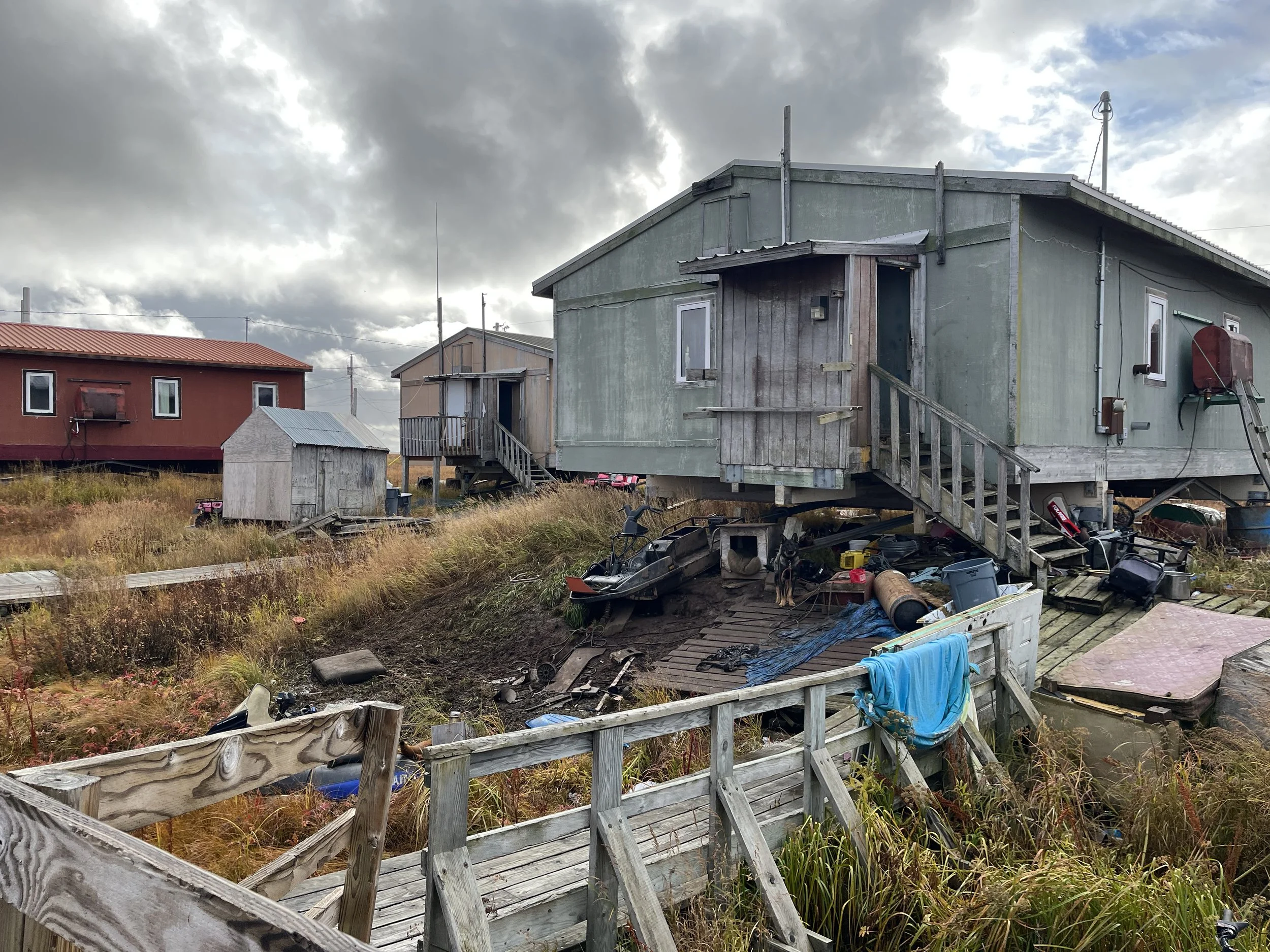
Some houses in Nunapitchuk sit on their own little hills as the soil erodes around them. Whole neighborhoods have sunk as seeping sewage mixes with the soil of the melting tundra. One long bridge on the southwest of town is blocked off now with a set of wooden planks. All of the houses in the neighborhood it once connected are abandoned.
Not far from the Johnson River, Natalia "Edna" Chase’s two room plywood home is one of the houses in especially urgent need. For the last decade, the ground beneath her house has been giving way.
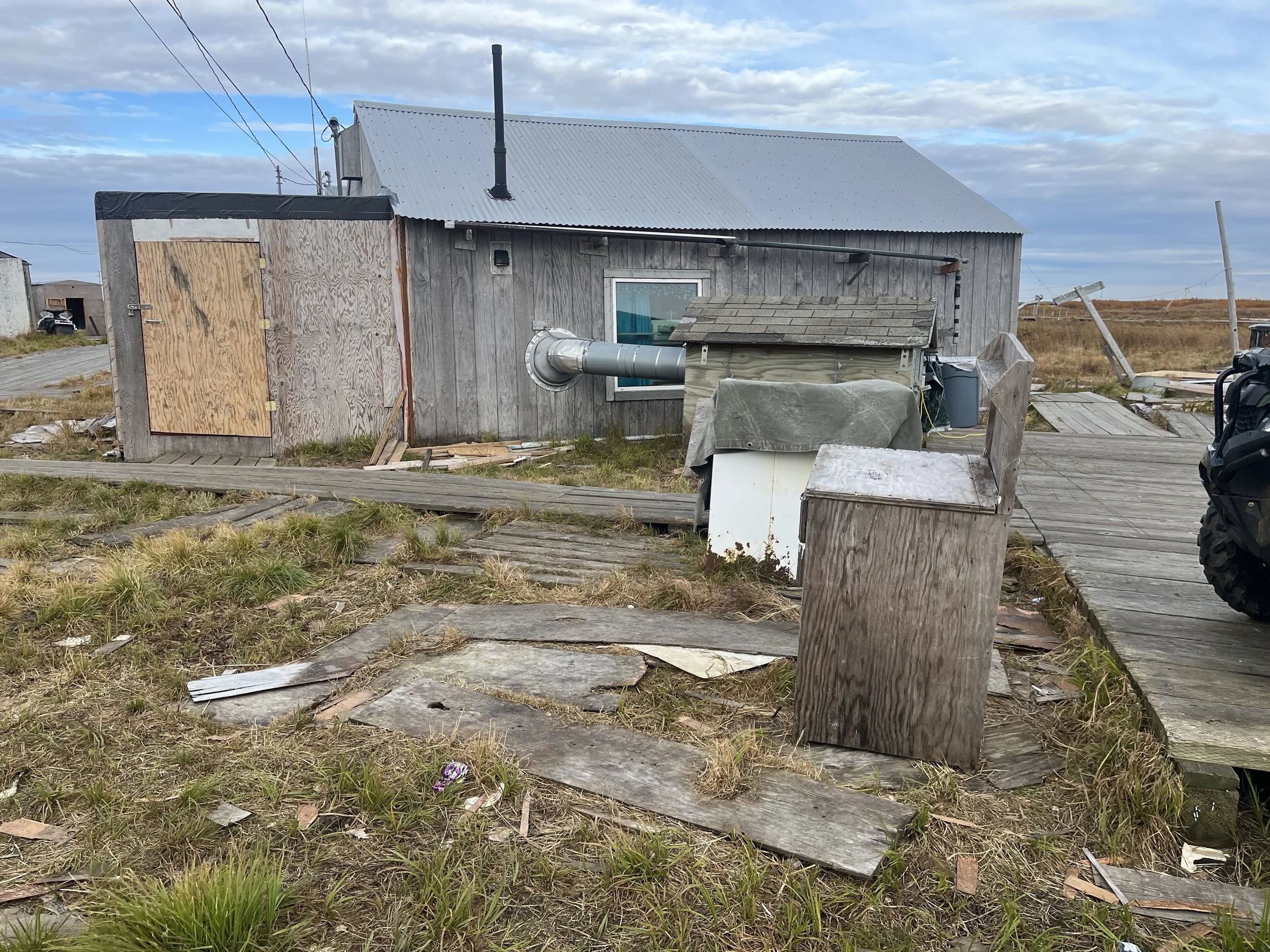
Natalia 'Edna' Chases' home, Sunni Bean, 2023.
Gaps form between the plywood floor, letting in frigid wind and blowing snow. Each time someone opens the door in the winter, Chase goes behind them and puts paper towels into the gaps with a butterknife. The floor is always moving, sometimes sloping upwards, tripping up her brother, who had a stroke and shuffles, and her partner, who struggles to balance since losing an arm.
“I've been trying to move around furniture because this side is sinking faster than before,” Chase said, pointing to the sagging floor under the kitchen. “We usually have rainwater coming in before winter and I have no place to put it, so we’re using buckets to bring the water in. For drinking and all that.”
Water pours in when the snow melts too. When there are sunny days in the spring, Chase stays up all night vacuuming the water gushing in from the corner of her floorboards and putting the water in a row of large buckets. Chase estimates that about 500 gallons of water flood into their home in the spring.
“I usually try to keep furniture up by using two by fours so the air can circulate under,” said Chase. “We have to keep it about 80 degrees every day to keep the floor dry. Sometimes I have five fans going on when it's really wet outside to keep the floor from getting too moldy.”
Every week, despite her chronic back pain, she moves every item and appliance and gets on her knees to clean underneath them. When she hasn’t kept up with constant cleaning, she’s seen mold patches that look like flowering orchids grow to the size of a football.
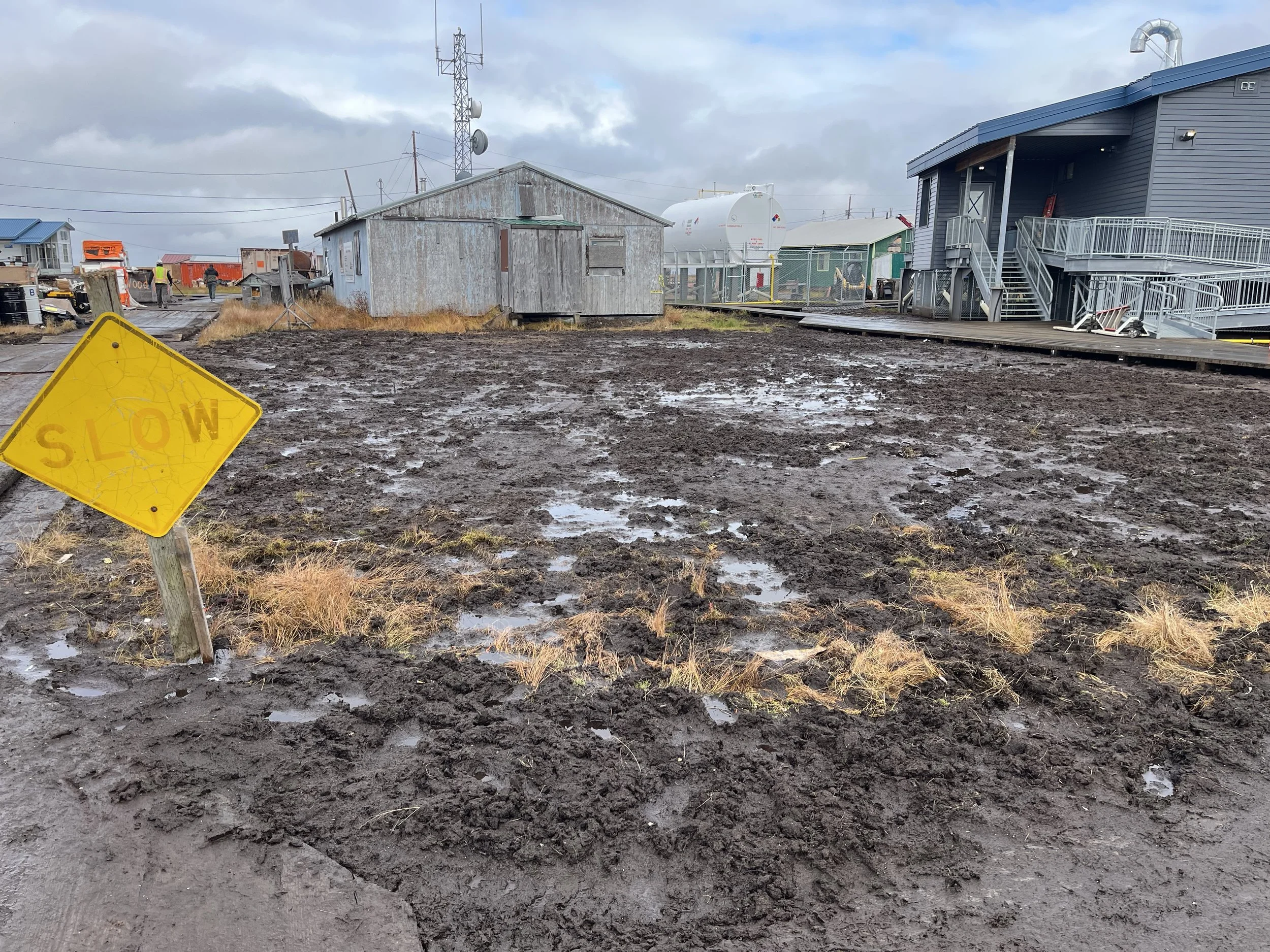
Where construction or buildings have been, there are now plots of dark, mushy mud. That land is unusable. It can’t be stepped on, let alone built on again.
One of the issues with building on the tundra is it’s already a loose material. Also the rivers are powerful, pushing shorelines and forming new, twisting sloughs. Up into the 1960s, local people moved with the seasons and used natural materials to build with. Those materials didn’t test the soil like modern infrastructure or leave harmful chemical byproducts.
“In the springtime, they would migrate to where they knew they would get some food that they could gather,” Alexie said. “And then in the fall, they would move to some different area to gather again for the winter.”
The community settled in Nunapitchuk mostly because of the school, but also because of the church. The federal government also made the decision to parcel up local land and transfer ownership to regional and local village corporations with Alaska Native shareholders.
In 1976, the state mandated that Alaska Natives attend local public schools with the Molly Hooch Act. That law was passed because of a case for better local education brought by a student from Emmonak and a student from Nunapitchuk, Anna Tobeluk, Village Police Officer Alex Tobeluk's grandmother. Residents say the state chose this spot for Nunapitchuk’s new school because it was the best place to build a port.
“It was very strictly required by the U.S. government. They were strict. They were strict enforcing, forceful that we get our education,” Alexie said.
But less than 50 years on, the school isn’t holding up well either. Anna Tobeluk Memorial K-12 School is third on the list of the state of Alaska’s capital improvement project priorities. So far, the state has allocated over $45 million for major renovations, ground reinforcement, and chemical hazardous materials abatement.
This school year, students in Nunapitchuk started back at school remotely because the back ramp of the school building fell off, revealing flaky, rotted wood. The school is overcrowded too, currently at almost twice its capacity, and with 96 unhoused students. Residents say that many of those students live with extended family.
“Out of our 750 regular people that live here, two-thirds are 18 and under, right?” Alexie said. “Look how much more houses they're going to need.”
On top of overcrowding in problem-ridden buildings, outdoor spaces where people used to spend much of their time are increasingly unsafe too. The shrubs, moss, and small bushes that defined the rugged ground have given way to spongy mud and grass, threatening the historic subsistence lifestyle.
In the third part of this four-part series, KYUK will look at the effect of the changing tundra on life outdoors in Nunapitchuk.
—-
Pt 3: As Nunapitchuk’s tundra gives way to mud and grass, outdoor life isn’t what it used to be
Locals describe the ground in Nunapitchuk these days as wet, spongy, squishy, and mushy.
“Mud, soft mud all around,” resident Morris Alexie said. He’s lived in Nunapitchuk all his life, and now he’s trying to build a case to relocate the village. He says that it isn’t safe to stay on anymore.
“We are in the marshlands. As the bigger maps will show, our area is like a polka dot. Polka dots; those black spots are land,” Alexie said, pointing at the shrinking bogland on a map inside his office. “Now the rest is water.”
Outside the tribal building, Alexie pushed a spare two by four into the grass off the slanted boardwalk to prove a point.
“It's so soft all the way through. See? There's nothing. I haven't hit bottom yet,” Alexie said as water splashed below. “Look at it move. Look at it move!”
The tall grass beside the plywood jiggled. The characteristic moss, small shrubs, and herbs are few and far between.
“These are water plants, constant water plants. They're not regular grass,” Alexie said. “This is becoming a norm everywhere.”
Residents stick to the boardwalks, but the pathways quickly become frayed, wet, twist at strange angles, and frequently need replacing. At one point I took a step on what looked like a muddy patch on the boardwalk and was thigh deep in mud. Alexie pulled me out. A neighbor poked his head out to see if he could help. “I never walk that way, never!” He shouted from his porch.
Alexie, meanwhile, was sort of delighted. “I'm very happy that you experienced it firsthand," he said. “I thought you wouldn’t really understand what I meant. There’s becoming quicksand everywhere.”
But others have taken deeper falls into the mud. Residents pointed at different routes that they used to take, but don’t anymore. Places where the old, thinner boardwalks got sucked into the soil, and routes through the tundra they wouldn’t brave these days. There’s places on the boardwalk that routinely get flooded or always having sitting water, that people find new routes around or walk through in muck boots.
Alexie sees how quickly the pathways are getting sucked into the soil.
“This one is new. It is not too long ago, maybe I'd say five years, and already they have to make better access to it because it's already sinking in,” Alexie said, pointing at a warped part of the boardwalk with a second layer of boards on top. “They had to put this because the regular walkway is starting to go underwater.”
Alexie pointed at patches of houses and recalled when he took photos of them in the spring, completely flooded. Alexie’s cousin, James Berlin Jr., said that with the state of the soil, it isn’t safe or even possible to practice aspects of the Yup’ik lifestyle he grew up with.
“My parents didn't worry about me when I was a kid running around. Because it was firm ground back then. Frozen tundra. And we'd spend hours on the tundra plain, eating berries. Looking for eggs. Just all kinds of stuff, you know. Between our house and the lagoon, if you walked right now, it'd be ankle deep. Knee deep in some places.”
Now, Berlin Jr. said, kids don’t have as much freedom as he used to or much to do in general. But he gets why. “If my kid was about, I'd make sure he stays on the boardwalk. Not running off on where I used to run on as a kid,” he said. “It's not safe, especially with the lagoon being in the middle of a village.”
Fishing is different too. Berlin Jr. used to go right down to the shore with his grandpa and dip net for whitefish. Now, because of erosion, the water is too shallow.
“We used to have ducks come and nest on the riverbanks, so my grandma would, in the springtime, she'd walk the bank to get some duck eggs for breakfast,” said Berlin Jr. “And if you notice, I'll put up my motor before we launch and before we park, whereas we used to be able to just leave the motor down and have fish swim in right off the riverbank from us. Now we have to search for them.”
The permafrost itself was a tool in subsistence practices too, used to refrigerate and preserve food and ferment fish. That’s not the case anymore.
“You used to be able to take a shovel, and just take the top layer of the tundra, and make what we call our whitefish, to ferment our whitefish. We used to be able to just take the top layer off and put the fish in permafrost; it would be less than a foot. Now if you take a shovel in the same spot that we used to make them, you won't get to the permafrost. It'll be all squishy mud-clay. With a spade shovel, you know, spade shovel isn't very big,” said Berlin Jr.
With fewer harvested meals and more processed foods in local diets, there’s been an increase in chronic diseases in Nunapitchuk as well. The community's health has declined. According to the Yukon-Kuskokwim Health Corporation, Alaska Natives in the region have a life expectancy that is 10 years below the national average due to diseases like cancer, diabetes, and heart problems, which are related to diet. That means Nunapitchuk no longer has the Elders it used to, who would pass on generations-old knowledge about the land and culture.
“I grew up in the village with our Elders in the[ir] nineties; they would pass away in their nineties,” said Alexie. “And today, the oldest male in the community is late seventies now.”
With the community settled and the ground giving way beneath the village, aspects of the Yup'ik culture that have lived on are becoming less tenable. This fall, Nunapitchuk’s tribe, city government, and local corporation unanimously passed a resolution that they want to move the entire town. Community members overwhelmingly supported the decision.
In the final part of this four-part series, KYUK will explore how the village of Nunapitchuk builds its case to relocate.
The sky was an unusually clear blue on a crisp October afternoon, but wind kept blowing the narrow black drone off its delicate course. And the battery kept dying.
Tom Kurkowski and science communicator Mike Delue, drone pilots with the University of Alaska Fairbanks (UAF) International Arctic Research Center, weren’t going to give up on getting the drone into the air to photograph parts of Nunapitchuk in sharp detail.
“I bet every pilot is like, 'I wish I had a weather control device,'” Delue said as they waited for the wind to die down. The drone would rise up and hover before climbing to precisely 400 feet, while Delue and Kurkowski monitored its course on a screen. The drone had to be steady as it scanned the town, creating a grid out of lots and lots of pictures.
“Landing,” Delue said, catching the drone. “So I'll just grab it. And then that's the readout of everything. So that's the photos that have already been taken: 1,328 photos, but there's 2,158 photos to cover that polygon, that area we wanted, and it's just some other details.”
“Those photos will have a lot of overlap between them. Each photo, in software, we can then fit them together like a puzzle piece. And you see the school here, and the school here in the same photo,” Delue said, pointing to the tiny dots filling the screen. “You slide them together. And you do that over and over and over again, and you end up with a photo of town. It looks like a satellite image, but at a much higher resolution.”
Sunni Bean// Drone photos taken of the center of Nunapitchuk.
The images map the depth of the ground surface, showing how high and low the land is in what’s known as a digital surface model. UAF faculty will come back and scan the village again in a year or two to track how the ground has changed.
Nunapitchuk is one of 10 communities in the Yukon-Kuskokwim (Y-K) Delta that will be scanned and rescanned again in the coming years. That will help researchers understand a root question: how is permafrost in a changing climate affecting the ground surface and, in turn, everything that sits on top of it?
“Once we can take another model, say after the summer or next fall, then when that changes the deck detection, where we can see ‘Oh, this used to be 1 foot above river level and now it's 0.7 feet above river level,’” Delue said. “Then you can start to examine: ‘Was that because of permafrost that we're seeing those specific changes? And what's the rate of that change?’”
Permafrost melt’s colossal impact on global emissions
Right now, there’s not much known about the effects of permafrost melt on the climate, carbon emissions, and local populations. It’s an issue globally, because the perennially frozen layer of ground beneath the tundra holds a massive amount of ancient carbon.
The icy layer beneath Nunapitchuk has stored ancient organic material for millennia, that it releases when it thaws. A 2022 study in "Nature" wrote that Arctic permafrost stores almost 1,700 billion metric tons of frozen and thawing carbon, as well as microbes, chemicals, and greenhouse gasses. How much of that gets released will have a major impact on the planet. A 2022 study in the "Annual Review of Environment and Resources" wrote that if nothing is done, the high-range scenario estimates Arctic carbon emissions from permafrost melt to be equivalent to 100 years of emissions in 2019 from 22 European countries and the United States combined.
Scientists and environmental advocates are worried because the colossal potential emissions from thawing permafrost are largely left out of global climate models.
Permafrost Pathways: studying the Arctic
Delue and Kurkoski are gathering their drone-scanned information on Nunapitchuk because they’re part of Permafrost Pathways, a collaboration of scientists, policy experts, and tribal members stemming from a $41 million grant launched in 2022 to try to fill scientific and policy gaps on permafrost melt.
The initiative is led by the Woodwell Climate Research Center and partners with the Arctic Initiative at Harvard Kennedy University, Alaska Institute for Justice, Alaskan villages, and others. They’re also working with 10 villages, including Nunapitchuk, to help them adapt, work with government agencies, gather data, and drive policy change.
Woodwell Research Center Senior Scientist Sue Natali is the project lead for the Permafrost Pathways collaboration. She said that she started to notice permafrost degrading since she started working in the Arctic over a decade ago.
“More recently, in 2015, I started working on the Yukon-Kuskokwim Delta. And I can't quite remember the year, but I do remember then coming back and seeing land, say where I had been taking some measurements, and it was gone,” Natali said. “Because it was collapsing.”
“In the communities, I see it much faster. And as you know, like when I talk with people who are definitely younger than me, l hear people talk about changes in the landscape and vegetation. Like, ‘I used to go berry picking here,’ and then you see that's now, like, a wetland. That’s really quite startling. There’s also lakes that go away from one year to the next,” Natali said.
According to a 2022 study published in the journal "Communications Earth and Environment," the Arctic has warmed almost four times faster than the rest of the globe. This warming is known as Arctic amplification. The University of Alaska’s Alaska Climate Adaptation Center’s Northern Climate Report predicts Nunapitchuk’s average annual temperatures may increase by about 13 degrees Fahrehneit by the end of the century. Nunapitchuk is already on relatively warm permafrost. Using NOAA’s Earth System Model, the report shows that there will be almost no permafrost left under Nunapitchuk by 2099.
When Natali imagined Nunapitchuk’s landscape in 150 years, she said that it will look different.
“Hopefully we'll have control of our climate in 150 years. And then the land, some of it will have been lost, you know? I mean, erosion is lost, it’s not going to build itself back up that quickly,” Natali said. “Some will be lost with big, abrupt land collapses that will be lost. Some places will probably be more wetlands, you know, areas where the ground is sinking, areas where some of the ground has gone underneath the water. But I really do hope in 150 years, we are on a very, very, very different climate trajectory.”
Building policy around Nunapitchuk to expedite relocations
The Alaska Institute for Justice, a nonprofit created to defend Alaskans’ human rights, is part of the Permafrost Pathways group. Robin Bronen, the co-founder and executive director, said that the institute began to assist Nunapitchuk after a 2009 report identified the communities most imminently threatened by permafrost melt. The institute reached out to see if those communities wanted their support, and 15 said yes.
“Nunapitchuk was one of those communities,” Bronen said. “So we began supporting the tribes who wanted to work with us on doing the community based environmental monitoring, and then also doing this ongoing policy analysis to understand what the barriers were that were preventing communities from accessing the resources they needed.”
Alaska Institute for Justice also helped the village of Newtok in its ongoing relocation project to Mertarvik. Now it’s helping Nunapitchuk prepare for theirs.
“So for Nunapitchuk, what we're hoping is that that community's relocation can be a pilot project for the federal government, which is now way more engaged in the issue of relocation than when Newtok started this process 20 years ago,'' said Bronen. “A lot of advocacy was done by tribes to educate the federal government and Congress to this giantly complex issue that is now happening to several communities, right? That issue of community relocations.”
There are a number of other villages that want to relocate in the Y-K Delta. Newtok and Napakiak are already in the process. As of fall 2023, the shoreline was 73 feet from Napakiak’s school. The high school wing was knocked down already, and the principal's office was filled with storage boxes in case they had to evacuate quickly in a storm. At minimum, residents in Akiak, Chefornak, and Hooper Bay have expressed interest to move too.
Bronen said that they chose Nunapitchuk to be a pilot since the village already had selected a relocation spot, and they believe that it will be suitable for building infrastructure. It's also on land the community already has jurisdiction over, so there won’t need to beland exchanges like there were in Newtok. Plus, it’s getting increasingly dangerous for residents.
Nunapitchuk local Morris Alexie is proud to say that the chosen relocation spot is on hard packed sand that should last a while. Alexie was the first of eight local tribal liaisons with Permafrost Pathways. He’s the main person dealing with Nunapitchuk’s relocation, and the middleman for the players involved.
Alexie makes an effort to be on the forefront. He knows the main players personally, talks first in front of officials, and makes sure to go to conferences in Washington, D.C., Anchorage, and around the country to tell his community's story. In an ideal world, he wants to have a new village in the next five years, because changes to his community are happening fast. He said that he needs policy to keep up.
“Nunap[itchuk], this relocation effort, will be making policies and guidelines for the U.S. government, which does not have any kind of steps or ways that they take to relocate. We will be teaching the government on Alaska's relocation effort,” Alexie said.
There are a lot of other players involved, too many even for the main players to keep track of.
Bronen said that Alaska Institute for Justice is hoping that the federal government will use Nunapitchuk to start figuring out how agencies can collaborate with each other to fund the relocations. They’re also working to simplify applications so that villages can fill out one application for various departments.
“We need to have a good model of how that can be done, because it doesn't exist at this time,” Bronen said. “And then the work that we do is [to] help facilitate that coordination and collaboration. So we are working with different federal government agencies to understand what their capacity is to provide the support that Nunapitchuk needs right now.”
Bronen said that she hopes this collaboration will speed up the process, especially as more and more villages reach the breaking point for relocation.
“Newtok’s relocation has been happening for over 20 years. And communities like Nunapitchuk do not have 20 years for all of that collaboration to happen because of the environmental situation that they're in,” Bronen said.
The wide-ranging Permafrost Pathways collaboration stems from a six-year grant. Permafrost Pathways leead Natali said that long-term, she hopes to empower the communities to be in charge.
“Really, with the project it's like, ‘What can we do so that the communities can lead?’ And so that they can have the data, and own the data. And so that, you know, ideally, I would love to get us out of the picture,” said Natali. “Some of the work we will be doing with some of the communities and people who are interested is doing, like, our GIS training, so mapping, training on how to create maps. So it's not us creating the maps. But here's how you access these geospatial, you know, satellite data. And here's the tool.”
To that end, Alexie started conducting water quality tests at the end of town. Last summer, he said that he found traces of arsenic and mercury or acid.
What happens next for Nunapitchuk
In fall 2023, the village of Nunapitchuk completed its permafrost vulnerability assessment. According to Alexie, it projected the relocation to cost $277 million.
Now the village and the Alaska Institute for Justice are working with the U.S. Army Corps of Engineers, the main government agency that decides if they get the okay to move to a new site, which is expected to take about a year. First they will need to figure out a site for a new barge landing, and for an airstrip to provide access to the new village.
It’s far from the first time the community has relocated. They were always moving: from spring camp, to winter camp, to fall, to summer. They lived off what was plentiful that year, and would construct their living situations with the materials in the environment around them.
Colonization introduced a settled way of life with heavy, costly, and chemical-ridden infrastructure into a fragile ecosystem that's getting more fragile every year. Now, to feel safe, the community has to move again. This time, it won’t be as easy to pick up and restart.
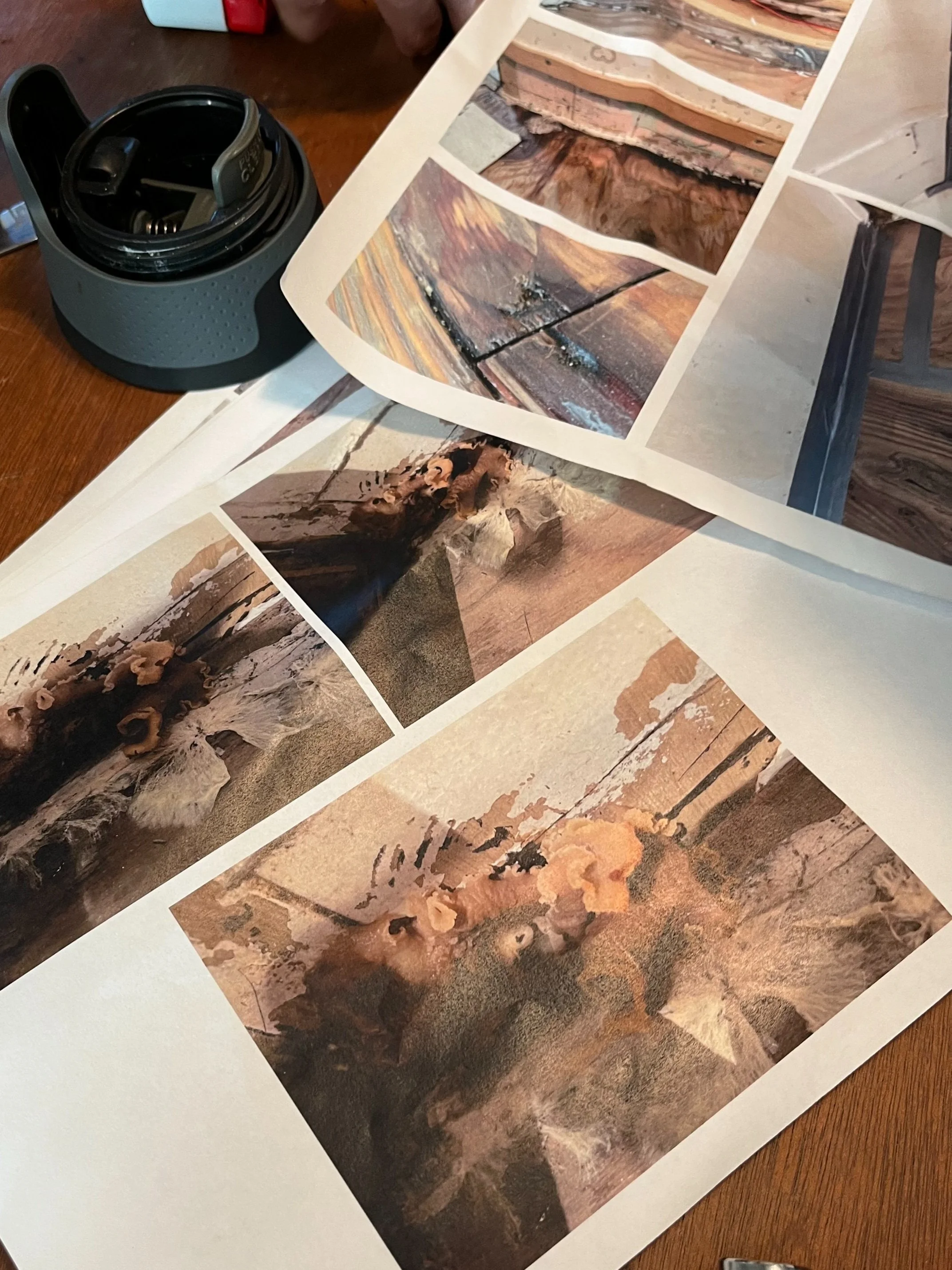
Mold growing in Natalia 'Edna' Chases' home, Sunni Bean, 2023.
“This mold, it sticks on clothes, it sticks on the bed, the mattress, everything. That moldy smell,” Chase said. “I have to rewash every clothes. I'll wash clothes. If I leave them out, they start stinking and I have to wash them again.”
Her partner has developed a chronic respiratory illness and recently her 14-year-old had to get an inhaler.
“It gets very depressing. Most days I can't shake it off until I.. I don't know, maybe get mad and it will shake off.” Chase said, trailing off. “But, we're trying to deal with it.”
Except for school for her son and medical appointments, they rarely leave the house. All of Chase’s time is devoted to taking care of the house and family. Chase worries about how her own health issues might mean she won’t be able to keep up with all the work. She too, has a chronic backache.
“I wouldn't want them to go through what I have been going through all this time with this house. It's very debilitating, especially when you're disabled. To see your partners cough away. And that black mold. I have to get started even though I'm hurting so much.”
The lots next to Chase’s home are empty, filled with abandoned chests of drawers and washers, heavy items that made the homes sink faster. Her neighbors knocked down their houses and some moved in with nearby relatives because of the flooding and increasingly unstable ground.
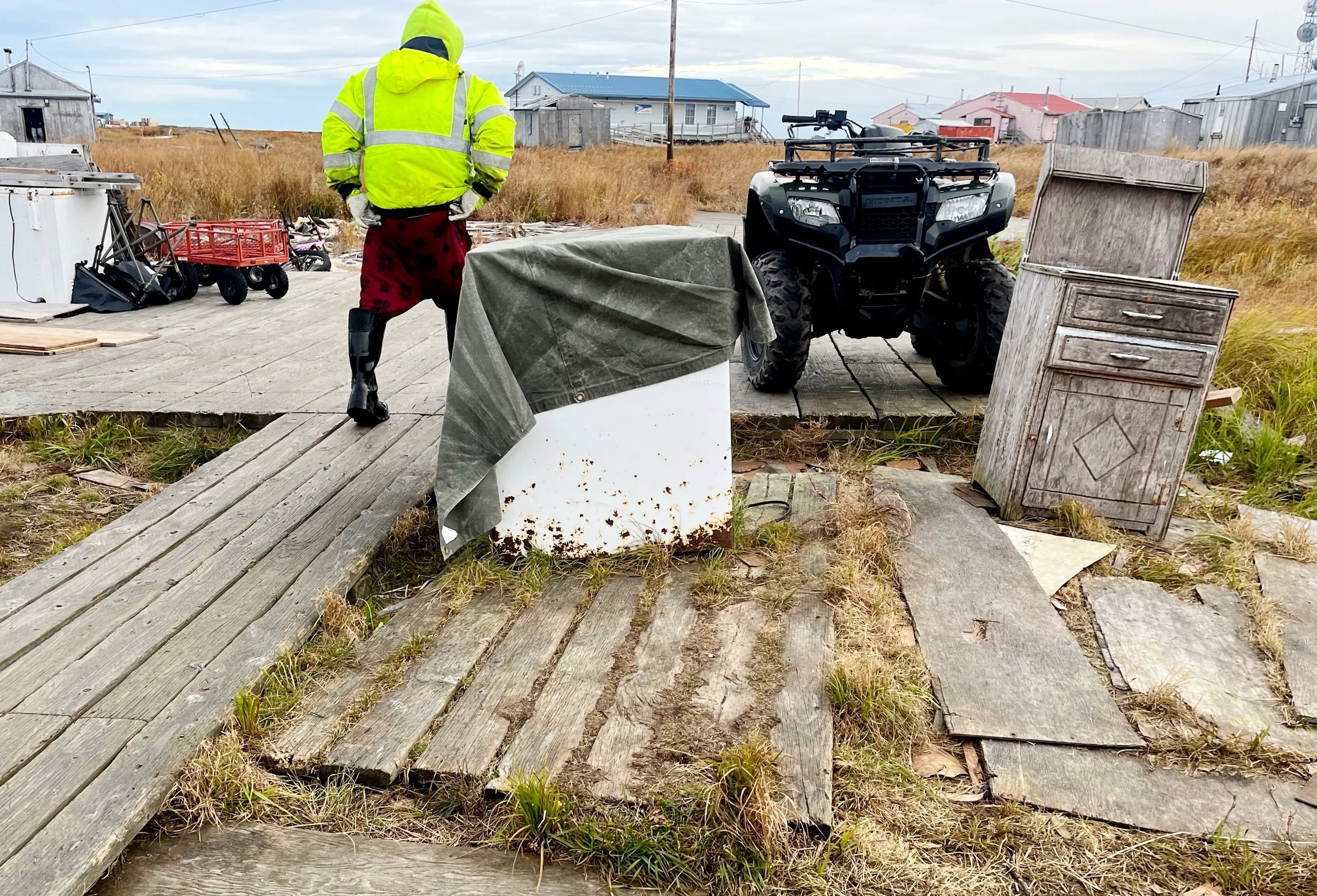
Heavy furniture that was abandoned beside Chase’s because it was causing houses to sink. //Sunni Bean
Chase wants to move too, but there’s nowhere to go. There’s no land in Nunapitchuk that’s good enough to build on anymore.
That means a lot of houses are overcrowded. James Berlin Jr. recently moved in with his dad.
“Practically everybody here, practically every family you know have multiple families living in houses now,” Berlin Jr. said. “Living conditions, with our water and sewer system, it's causing health issues that we normally wouldn't be seeing.”
Berlin Jr. said that he thinks their house is sinking because the nearby sewage lagoon is seeping out. Many residents point to the toxic chemicals in the multiple sewage lagoons dotting the center of town, soaking into the soil and speeding up the already rapidly-melting permafrost.
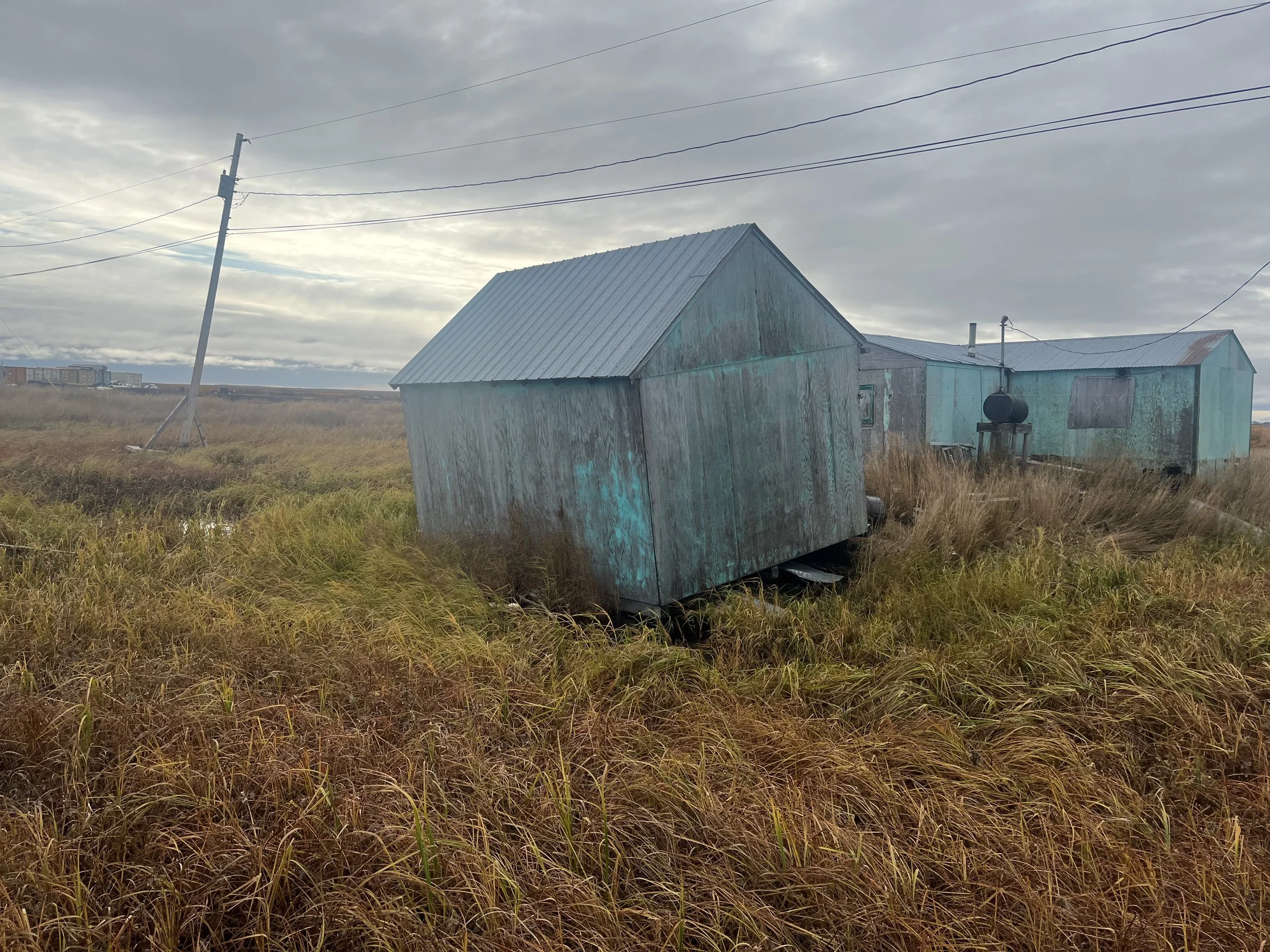
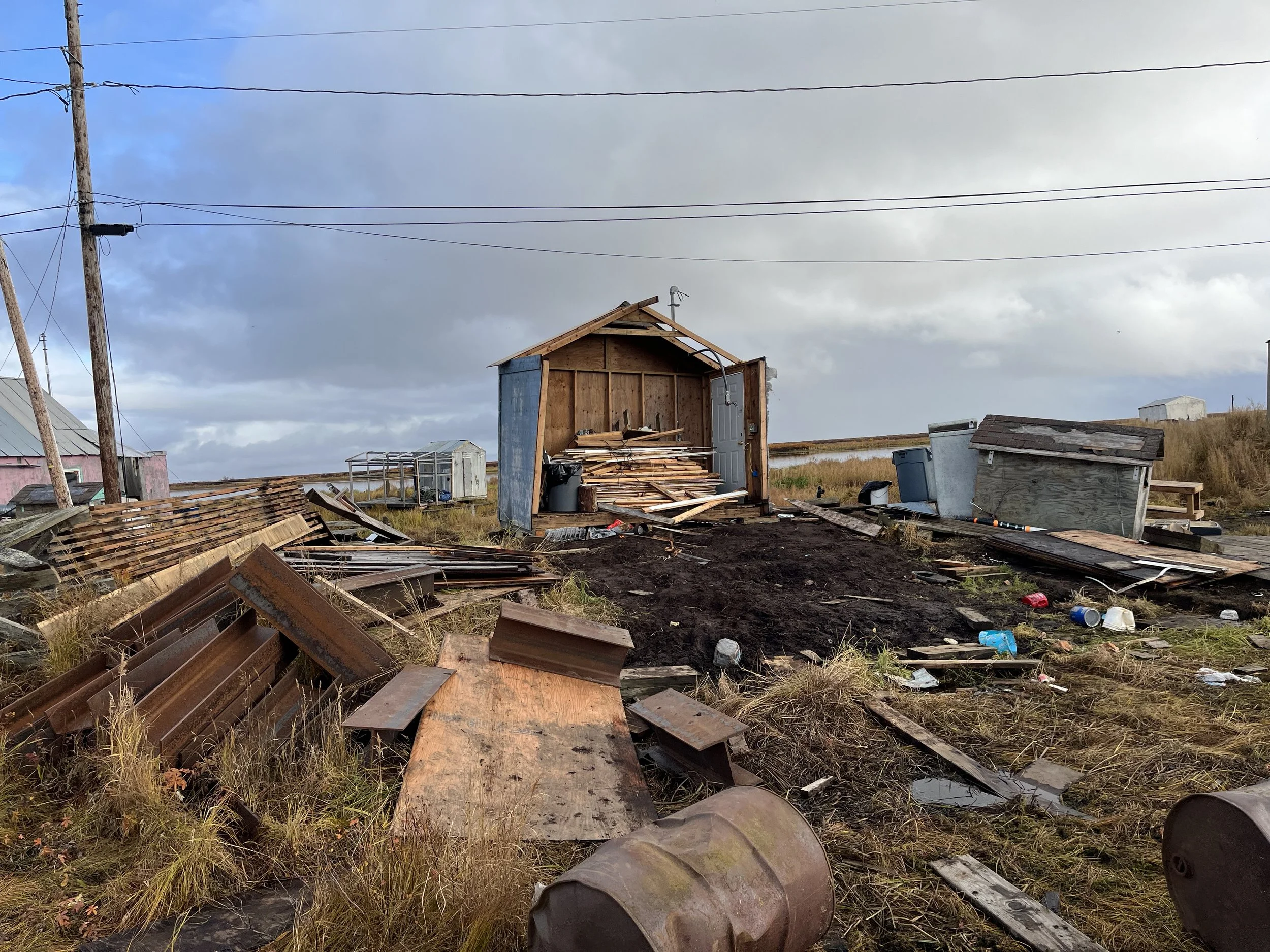
When we walked around, Berlin Jr. pointed at the large number of snowmachines gathered by properties for different members of households. Overcrowding was one reason Nunapitchuk was one of the first places in Alaska to see the coronavirus run rampant.
“I'm not saying everybody's sick, but you know, it's more common to see people going to the clinic for respiratory issues like colds, head colds, flus, sore throat,” said Berlin Jr.. “You know, all kinds of common flus and stuff that you see, but it's more so here in Nunap[itchuk] because we have multiple family units living in small spaces.”
It's not the first time the village has seen widespread disease, but in the past, one of their protections was the spread out nature of their community and their nomadic lifestyle. Nunapitchuk resident Morris Alexie explained.
“When they brought in, they call it the Black Death. If we were all gathered in a village like we're gathered now, I bet it would wipe out almost all of the community,” Alexie said. “But then since they were in, in tribal, in small tribes separately, that Black Death they called would leave, like, only one remaining family of that tribe.”
Permafrost melt doesn’t just make home life more difficult. All the infrastructure in town is having problems because of the eroding soil.
PT 2: In Nunapitchuk, infrastructure is increasingly UNSTABLE
The law enforcement building in Nunapitchuk sits on the shore of the dynamic Johnson River, which runs through the village. And the building is right on the shore. The riverbank has eroded to a foot away from one of the building's stilts.
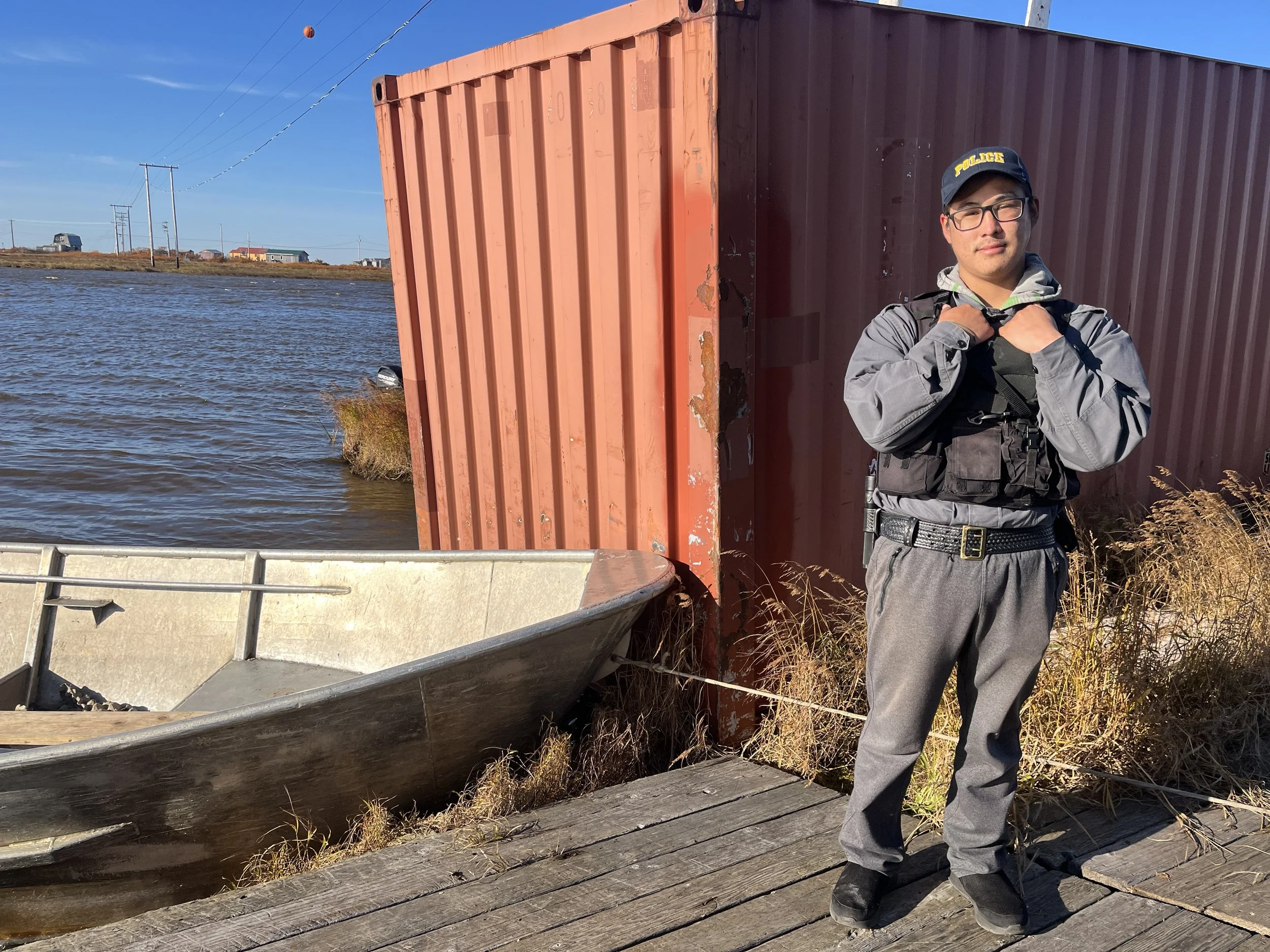
“I do hope they get a new boardwalk for this,” said Nunapitchuk Village Police Officer Alex Tobeluk. “It'll make it easier.”
The law enforcement building is small and gray, with jail cells in the back and printed signs tacked up banning cigarettes for prisoners and social visitors for staff. It houses the local police department, fire department, and ]search and rescue team: a team of four.
The groups boarded up the entrance they used to use to access their boats because of the erosion. Now they use a side door that leads to a haphazardly constructed dock. It’s janky, narrow, and missing planks. It's pieced together with loose nails and spare boards.
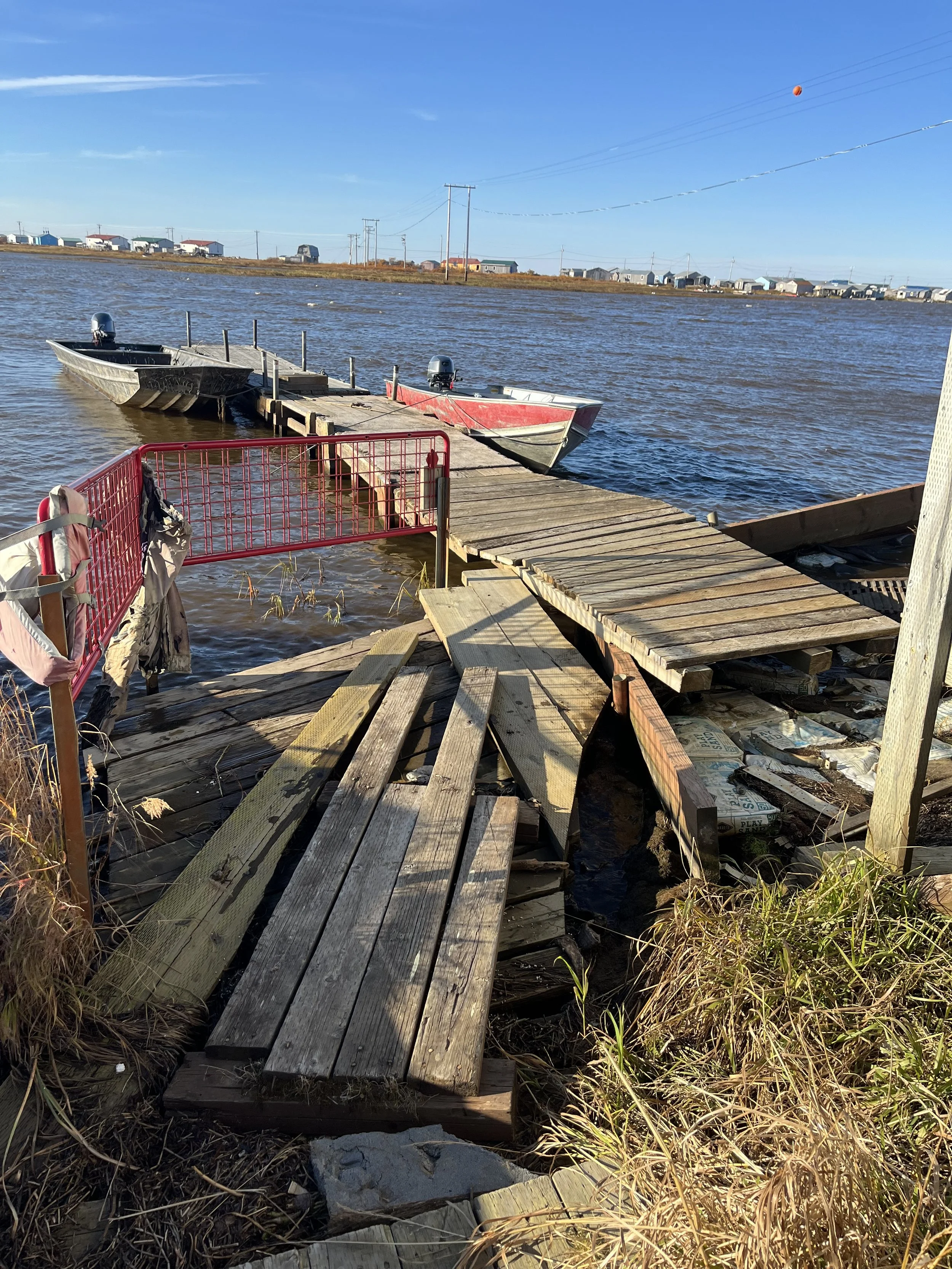
“Especially when we have an intoxicated person, bringing him here, like, because that boardwalk is narrow, I always get worried they might fall into the river. Because it’s so small,” said Tobeluk.
Tobeluk said that it can get particularly dangerous in the spring when the river is cold and water is high. The water overtakes the dock and gets the village police officers wet on their way to emergencies.
“And if they trip, like, you know, especially having handcuffs, you can’t use your hands to prevent you from getting hurt,” Tobeluk said. “So I do hope they fix it so that anybody won't get hurt.”
Tobeluk said that the police are nervous about the eroding shoreline, which is destabilizing the building’s foundation.
A bed of sandbags makes a fortress between the water and the grassy mud beneath the building. A stack of planks waiting to become boardwalks is serving a second purpose: propping up the building’s horizontal structural beams.
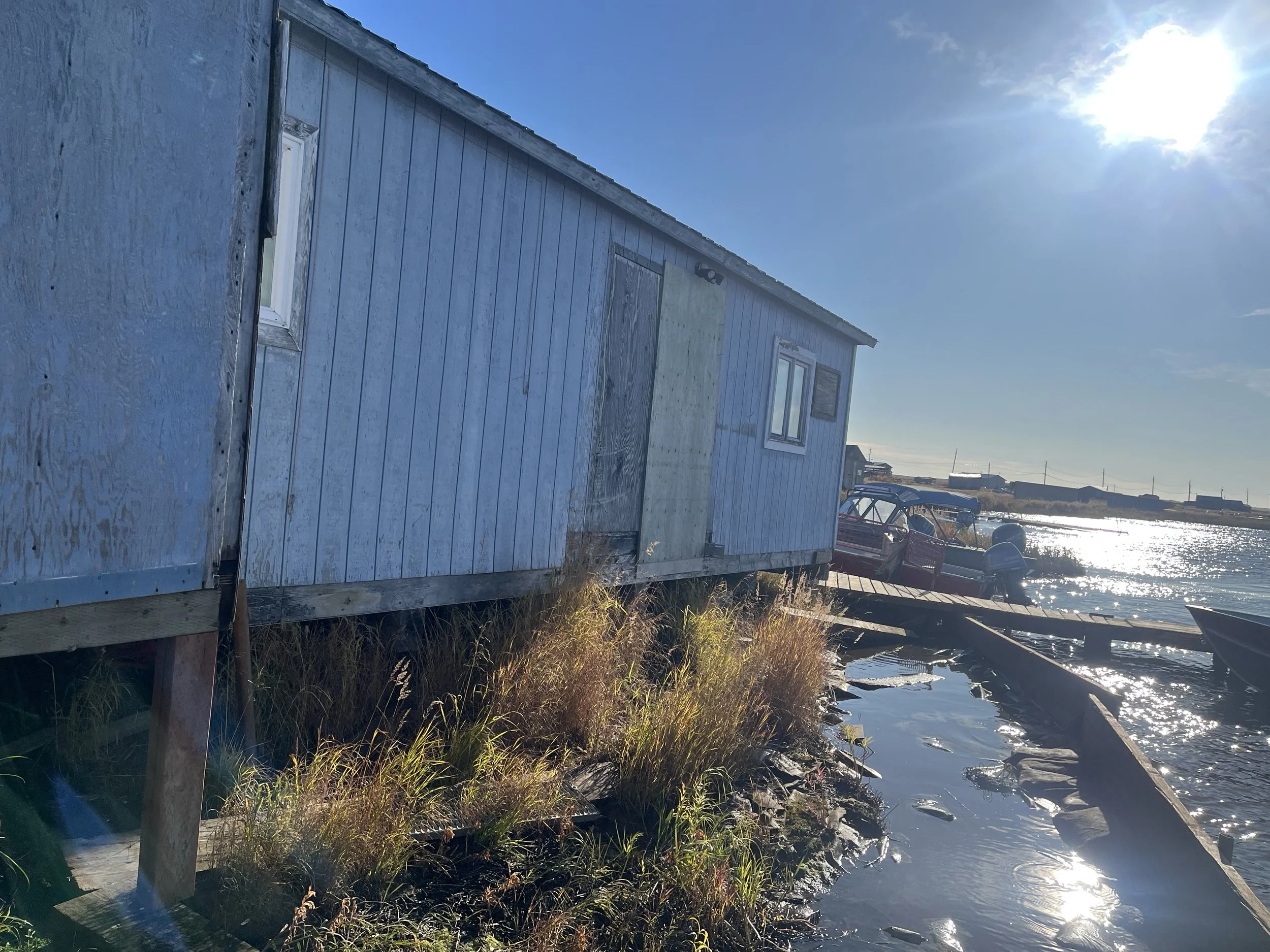
Where construction or buildings have been, there are now plots of dark, mushy mud. That land is unusable. It can’t be stepped on, let alone built on again.
One of the issues with building on the tundra is it’s already a loose material. Also the rivers are powerful, pushing shorelines and forming new, twisting sloughs. Up into the 1960s, local people moved with the seasons and used natural materials to build with. Those materials didn’t test the soil like modern infrastructure or leave harmful chemical byproducts.
“In the springtime, they would migrate to where they knew they would get some food that they could gather,” Alexie said. “And then in the fall, they would move to some different area to gather again for the winter.”
The community settled in Nunapitchuk mostly because of the school, but also because of the church. The federal government also made the decision to parcel up local land and transfer ownership to regional and local village corporations with Alaska Native shareholders.
In 1976, the state mandated that Alaska Natives attend local public schools with the Molly Hooch Act. That law was passed because of a case for better local education brought by a student from Emmonak and a student from Nunapitchuk, Anna Tobeluk, Village Police Officer Alex Tobeluk's grandmother. Residents say the state chose this spot for Nunapitchuk’s new school because it was the best place to build a port.
“It was very strictly required by the U.S. government. They were strict. They were strict enforcing, forceful that we get our education,” Alexie said.
But less than 50 years on, the school isn’t holding up well either. Anna Tobeluk Memorial K-12 School is third on the list of the state of Alaska’s capital improvement project priorities. So far, the state has allocated over $45 million for major renovations, ground reinforcement, and chemical hazardous materials abatement.
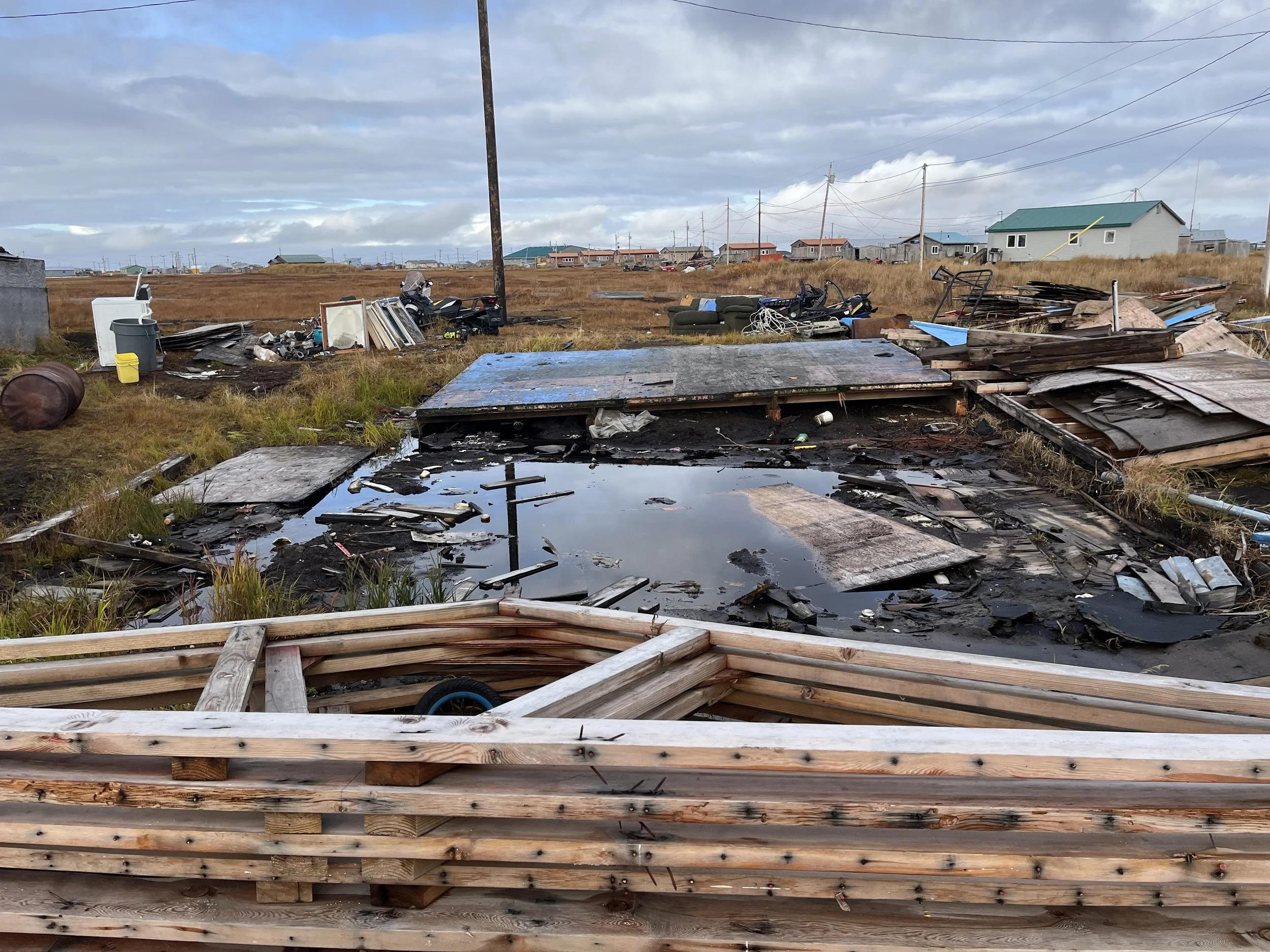
“And they pick them up, and they use, like, jacks to lift the building up and add more to the side. Since we would get problems with the building because it's shifting really bad,” Tobeluk said. “Like right there. They added more blocks.”
Nunapitchuk law enforcement wants a new building, but they’re not the only ones. The tribal office and post office are also sinking. Light poles lean precariously, and a fall of even one could cause a village-wide power outage. In 2018, the Moravian Church fell off its stilts with a crash during the summertime salmonberry festival. It was the fourth time the church had to be rebuilt.
“It was kind of like the main eye opener, main indicators that the very ground that we are making a living on was changing,” said resident Morris Alexie, who’s trying to relocate the village.
"Nobody is excluded," Alexie said. "All over. It's moving everything. Nobody, even in the center of the community, they are no exception."
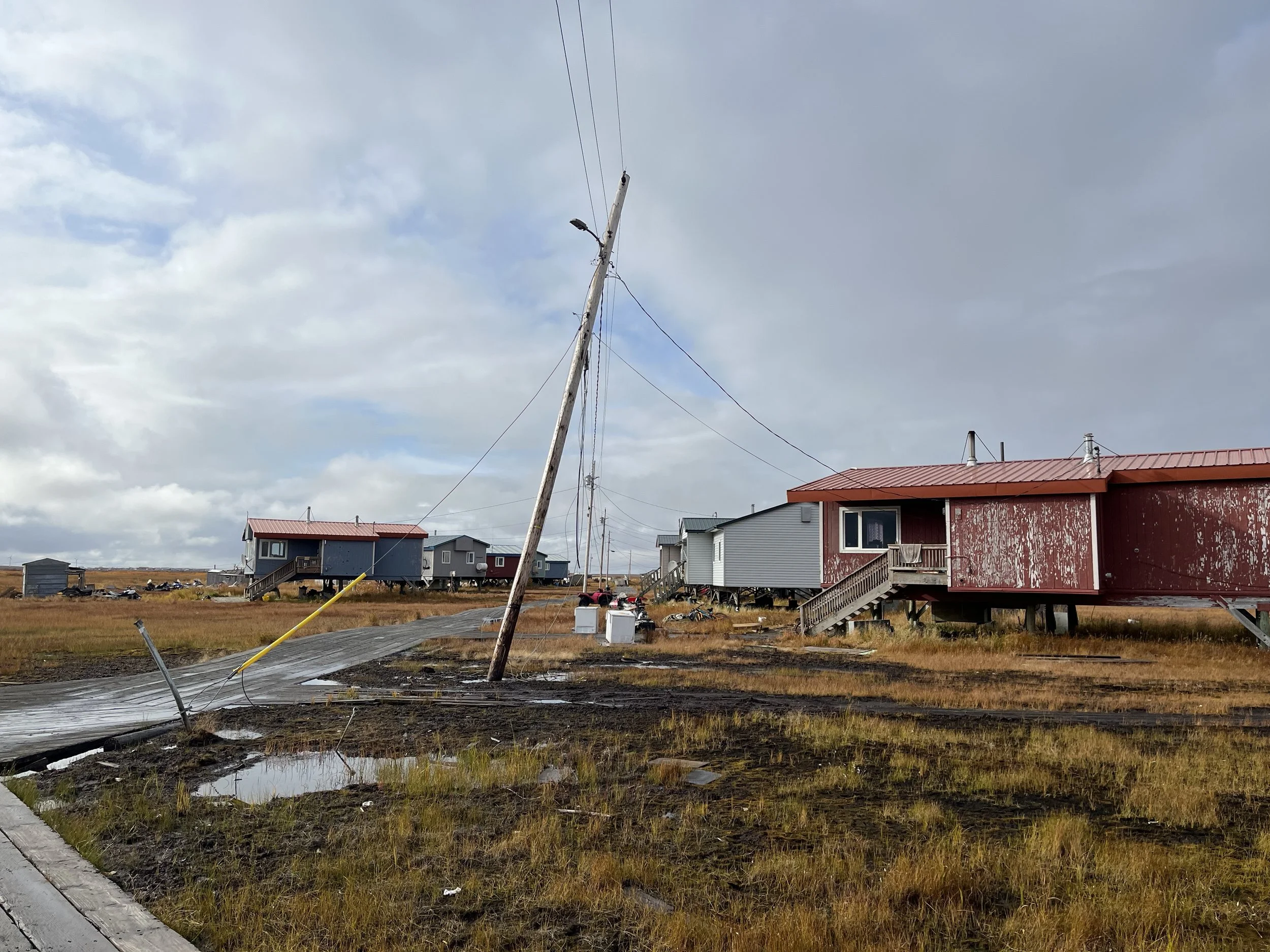
Light poles lean across town. A fall of even one could take out the power of the entire village of 800. Sunni Bean.